

Contenido de Peruvian Airlines
La historia de AeroPerú
La historia de AeroPerú se puede remontar a 1973, cuando el gobierno peruano consideró necesario crear una línea aérea de bandera que uniera las principales ciudades del país, separadas por una geografía muy difícil, así como para sustituir a la aerolínea APSA recientemente quebrada (Aerolíneas Peruanas Sociedad Anónima), que hasta 1972 había sido la aerolínea de bandera.
Así pues, el 22 de mayo del mismo año, Aero Perú fue fundado oficialmente, y se convirtió rápidamente en la primera aerolínea oficial del país. El primer vuelo de AeroPerú se realizó el 3 de octubre de 1973, hacia la ciudad de Cuzco, otrora capital del antiguo imperio inca, y ahora capital del turismo peruano, sirviendo como entrada a Macchu Picchu. La compañía inició operaciones con tres Fokker F28s, aeronave muy moderna en ese entonces. El lema de AeroPerú resumió la filosofía de la compañía: «trabajamos orgullosos para formar a un gran equipo y para llevar el nombre de Perú en alto.»
¿Que pasó con AeroPerú?
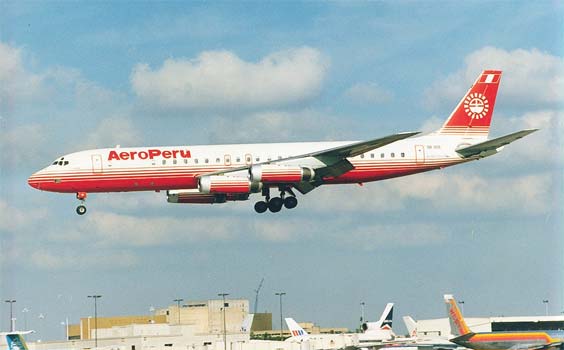
En 1974, AeroPerú emprendió un programa de expansión de sus operaciones, abriendo su primera ruta internacional hacia Buenos Aires vía Santiago. Por la mañana del 28 de julio, el Douglas DC-8 salió del Aeropuerto Internacional Jorge Chávez de Lima a Santiago de Chile en vuelo de tres horas.
AeroPerú rutas y vuelos
A través de la década Aero Perú anexó otros destinos internacionales que se sumaron a la lista: Miami, Los Angeles, Panamá, Bogotá, México, Caracas, Guayaquil, Quito, La Paz, Río de Janeiro y Sao Paulo. El crecimiento extraordinario emprendido durante los años 70 y los años 80 forzaron a la compañía a introducir mejoras en la flota. En 1978, AeroPerú fue la primera aerolínea sudamericana en introducir el avanzado Lockheed L-1011 TriStar. Fueron dos aeronaves las entregadas a AeroPerú, para sus rutas de mucha demanda, tales como Buenos Aires – Santiago – Lima – Miami una ruta tradicional, la mina de oro para las líneas aéreas peruanas.

Estas aeronaves fueron sin embargo, retiradas de la flota en favor de los DC-8s adquiridos de United Airlines pues sus costos operativos eran más económicos y se adaptaban mejor a la red de rutas de la línea aérea. Los Boeing 727-100s también fueron agregados a la flota durante los años 80. Hacia la mitad de la década, AeroPerú tenía un sistema de rutas internacionales y domésticas grande. La línea aérea enlazó Perú a Chile, Argentina, Bolivia, Brasil, Ecuador, Colombia, Venezuela, Panamá, México y Estados Unidos.
Privatizaciones – Caso Aero Perú
El 16 de enero de 1993, como parte del esfuerzo del gobierno en privatizar las empresas estatales, se puso a licitación la aerolínea para ser vendida al mejor postor. Esta fue adquirida por DBA Aeroméxico ( Aerovías de México), dirigido por Gerardo de Prevoisin. Las operaciones de AeroPerú crecieron y elevaron estándares y se adoptó una nueva imagen corporativa basada en la de Aeroméxico.
En 1995, como subsidiario de Aeroméxico, el control de AeroPerú fue asumido por el grupo Cintra, un conglomerado poseído por el gobierno mexicano, que adquirió los activos de los bancos mexicanos arruinados que se habían derrumbado durante la «crisis económica del Tequila». A partir de 1993 hasta su bancarrota en 1999, AeroPerú había establecido una alianza llamada «Alas de América» con Aeroméxico y Mexicana, que implicó derechos de código compartido, acuerdos, servicios de mantenimiento, y entrenamiento de tripulaciones. Fue incluida en este acuerdo la transferencia de modernas aeronaves para sustituir los viejos aviones que habían volado en la línea aérea por muchos años. Dos DC-10-15s y dos 727-200s fueron transferidos por Mexicana para sustituir los obsoletos DC-8s y F28s de la línea aérea. Cuando el DC-10 fue encontrado demasiado grande para las operaciones de la empresa, Aeroméxico transfirió dos 757-200s brand new. Para mediados de los años 90 AeroPerú había consolidado su posición internacional con servicios a las ciudades más importantes en toda América.
En 1995, AeroPerú unió Lima a Santiago, Buenos Aires, Sao Paulo, Río de Janeiro Asunción, La Paz, Santa Cruz, Quito, Guayaquil, Bogotá, Caracas, Ciudad de Panamá, Cancún, San José, Ciudad de México, Miami, Nueva York, Los Ángeles, Isla Margarita, Punta Cana y Varadero.
A partir de 1997 a 1999, AeroPerú basó su flota en dos tipos de aeronaves: el Boeing 727 ( versiones 100 y 200 ), para las rutas domésticas y suramericanas, y el eficiente Boeing 757-200 para las rutas transcontinentales a los Estados Unidos, México, Brasil, Argentina y Chile. En una tentativa de mejorar su condición y servicios financieros, AeroPerú continuó su crecimiento con la cooperación de Aeroméxico y de Mexicana en la alianza «Alas de América», mientras que también formó parte de otra alianza con la aerolínea ecuatoriana Saeta, llamada «Alianza Andina».
La tragedia de AeroPerú el accidente del vuelo 603
Sin embargo, las cosas se tornaron difíciles en 1996 cuando una de sus aeronaves Boeing 757-200 se estrelló en el Callao, en la costa de Lima, en un vuelo rutinario a Santiago de Chile. 70 pasajeros fallecieron en el vuelo, fue de hecho el día más triste en la historia de la aerolínea. La línea aérea perdería muchos clientes mientras que su imagen quedaría desprestigiada después del descubrimiento de la causa del accidente: alguien en su base de mantenimiento había olvidado de quitar una cinta que cubría las ayudas visuales que dirigían la aeronave. Aparte del rédito perdido incurrido en mala publicidad, la aerolínea se vio en la obligación de pagar más que USS70 millones en daños a los miembros de las familias de las víctimas.
Ultimos esfuerzos de AeroPerú
Antes de septiembre de 1998, AeroPerú consideró adquirir un 767-200ER o -300ER (*) y decidió además el reemplazo de los Boeing 727. Los problemas financieros junto con la feroz competencia de AeroContinente, forzaron a AeroPerú a volver a operar los Boeing 727s en febrero de 1999. Estas aeronaves fueron substituidas posteriormente por un pedido de ocho Boeing 737-300 de gran capacidad y eficiencia de combustible, operados previamente por British Airways. En un esfuerzo por mejorar su productividad, un nuevo acuerdo de código compartido fue suscrito con Avianca, para el segmento Lima – Bogota, y con Servivensa, en las rutas Lima – Caracas – Porlamar y Caracas – Punta Cana.
(*) A comienzos de los años 80, AeroPerú opero en wet lease con la inglesa Britania un Boeing 767 200ER para sus operaciones internacionales.
En un esfuerzo por inyectar dinero en efectivo muy necesario para las operaciones, Cintra vendió el 35% de sus acciones en AeroPerú a la aerolínea Delta Airlines al inicio de 1998. Delta consideró esto como una gran oportunidad de aumentar su presencia en América Latina desde su centro de conexiones en Atlanta. La empresa norteamericana inyectó capital para mantener las operaciones de la compañía. El mismo año, los operadores peruanos consideraron establecer una serie de rutas regionales con 4 – 5 Jetstream 32s, no obstante, después de un año de la compra de acciones por parte de Delta Airlines, AeroPerú no pudo elevar sus operaciones hasta cumplir con los estándares de Delta, lo que no dejo satisfechos a la gente de Atlanta. Por lo tanto, en marzo de 1999, Delta Airlines y el grupo de Cintra rechazaron la inversión adicional en la compañía.
Chabuca Granda en AeroPerú
El cierre y bancarrota de Aero Perú
AeroPerú buscó desesperadamente un nuevo inversionista para venir en su ayuda. Continental y American Airlines demostraron gran interés, pero al analizar la futura operación, sumado a la difícil situación política que el país estaba a punto de enfrentar, decidieron retroceder antes de cerrar el trato.
Los grandes problemas financieros que plagaron la línea aérea como resultado de un mal proceso de privatización, determinaron el cese de AeroPerú, declarándose el 10 de marzo de 1999 el día final de la aerolínea. A la fecha de la paralización, la empresa tenía una deuda de USS174 millones, una suma cuantiosa para una línea aérea con solamente 10 aeronaves (tres 727-200s, cuatro 737-200s tres 757-200s). La flota entera fue vuelta a los arrendadores en mayo de 1999.
A partir de 1999, fueron varios los intentos por reflotar AeroPerú, incluyendo uno de Continental Airlines y otro por parte de los trabajadores de la empresa, comandados por Celso González y Eduardo Wasli. Un 737-200 (N412CE) había sido arrendado y llegó con el nuevo esquema de pintura hacia septiembre de 2000, asimismo se daban los toques finales a un 727-200 ADV, que en su momento fue operado por la fenecida Americana de Aviación. Sin embargo, las difíciles condiciones económicas y políticas del país, obstruyeron el relanzamiento de AeroPerú. La bancarrota marcó el final de una era en la aviación comercial peruana y el principio de nuevas empresas que reflejan una liberalización de los cielos, y un gran esfuerzo de hacer de Perú el centro del turismo latinoamericano.
Si quieres hacer peruvian check in visita la página principal